Data from the manufacturer's datasheets • KombiTec GmbH
KombiTec DK dual welding heads – from micro-welding to 1500 N
Gap, step and thermocompression welding • force 0.2–1500 N, current up to 25 kA
KombiTec DK dual welding heads are used for resistance welding with parallel electrodes: gap welding, step welding and – on the smaller models – thermocompression welding, including enamelled wires. The family covers four sizes: from the DK-2004 for micro-joints with forces from 0.2 N, through the DK-2012 and DK-2015, to the DK-2110 with 1500 N per electrode. All have ±0.01 mm repeatability, and displacement sensors and force measurement can be added at any time. The heads fit HA stations and automated lines.
📸 Photos from the datasheets (click to enlarge):
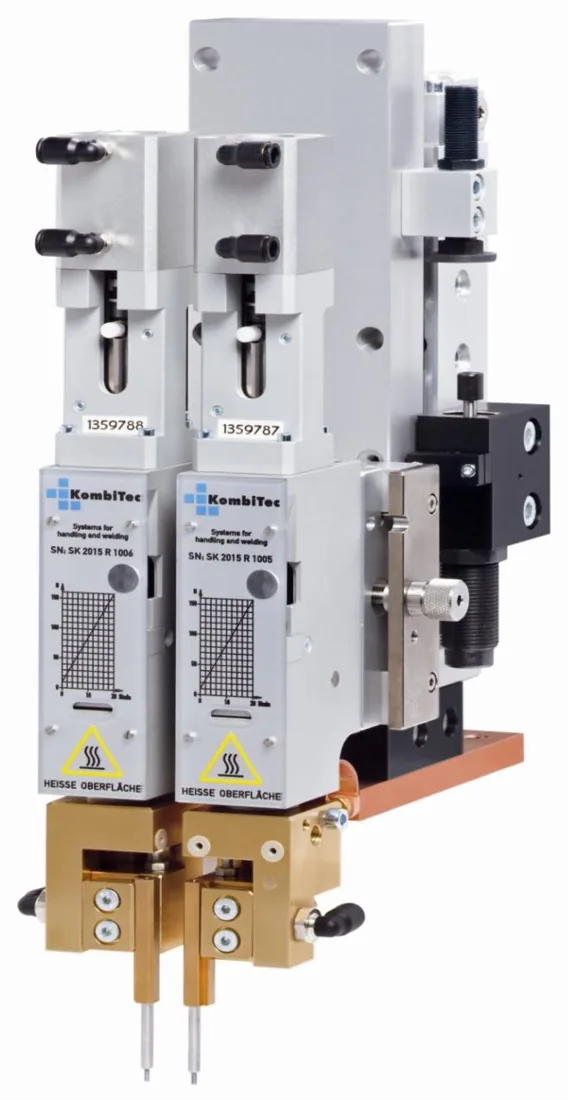
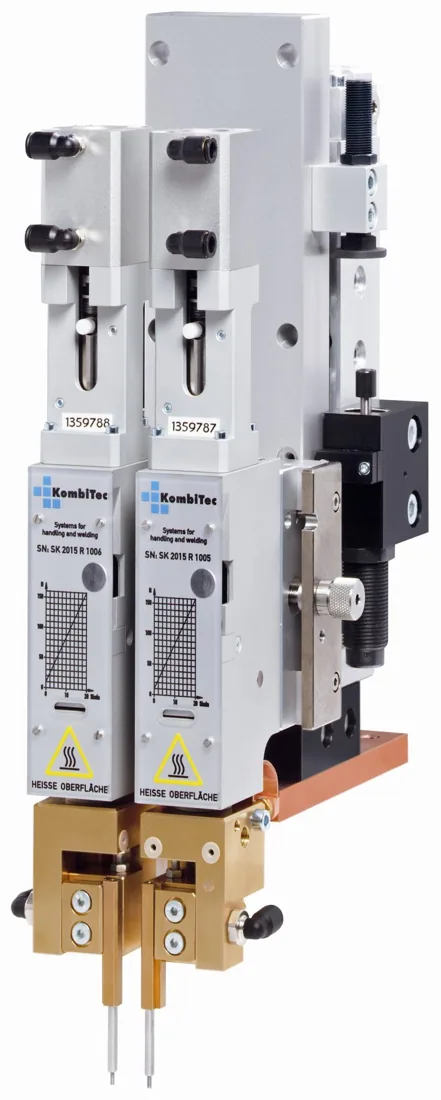
🔍 KombiTec DK-2015 – dual head up to 200 N per electrode
DK-2004 – micro-welding head, force 0.2–20 N
DK-2012 – head up to approx. 100 N
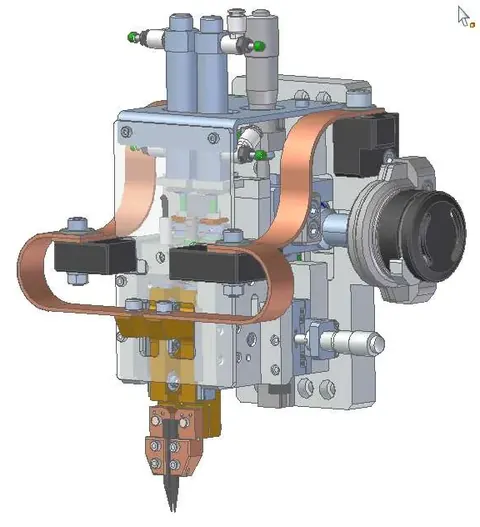
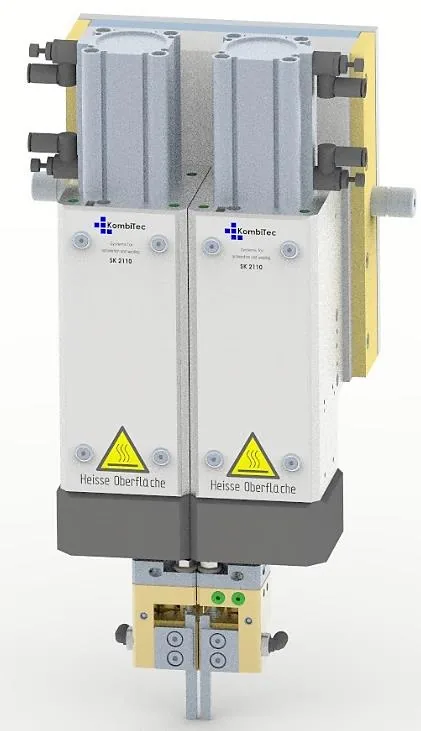
DK-2110 – head up to 1500 N per electrode
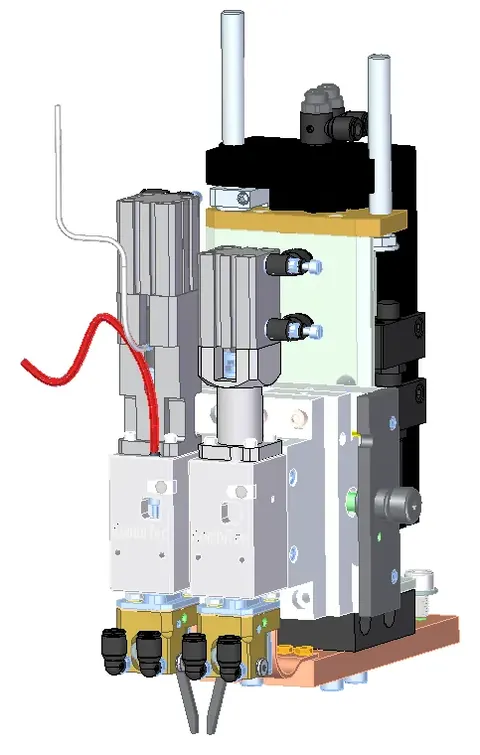
DK-2015 with linear module
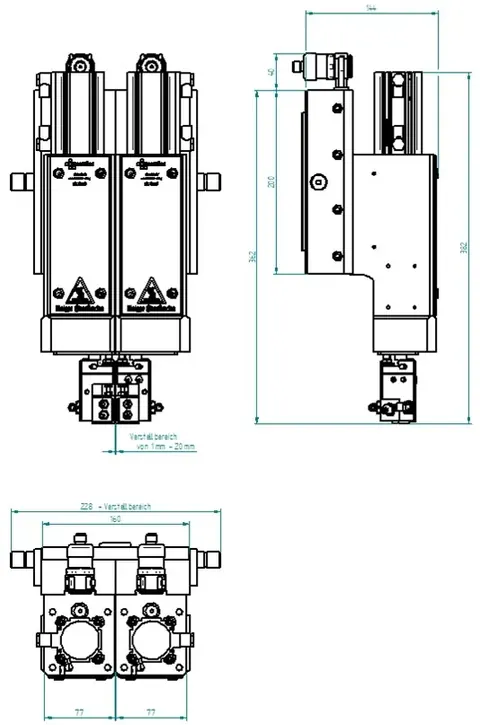
DK-2110 dimensional drawing
Models in the DK family:
🔬 DK-2004 – micro-welding
Very small parts and minimal forces of 0.2–20 N: gap and step welding, thermocompression of enamelled wires and SMD components on PCBs. Quick changeover between thermode and electrode operation, optional digital microscope with monitor.
⚙️ DK-2012 – approx. 100 N
Small, easily adjustable electrode forces: tungsten filaments on molybdenum pins, thin wires on ceramic substrates, automotive sensors, small soldered joints, battery cells.
🔧 DK-2015 – approx. 200 N
Mid-range gap welding, stroke up to 60 mm, continuously adjustable damping, direct force measurement at the electrodes. Also demanding battery and accumulator components.
💪 DK-2110 – 1500 N
Medium and high electrode forces per electrode, current up to approx. 25 kA: sensors in mouldings, electronic components, photovoltaic contacts, household appliances and consumer electronics.
DK head comparison (per KombiTec datasheets):
Model
Electrode force
Cylinder
Stroke
Operating pressure
Max. current (20% duty cycle)
Weight
DK-2004
0.2–20 N
Ø 10 mm
max. 15 mm (eccentric), follow-up travel up to 5 mm
0.5–5 bar
approx. 3 kA
approx. 3.5 kg
DK-2012
approx. 100 N (5 bar)
Ø 16 mm
7 mm
0.5–6 bar
3 kA
14.1 kg*
DK-2015
approx. 200 N per head (5 bar)
Ø 20 mm
60 mm, follow-up travel 4.5 mm
3–6 bar
6 kA
15.6 kg with linear module
DK-2110
1500 N per electrode (5 bar)
Ø 40 / Ø 63 mm
approx. 30 mm, follow-up travel approx. 3 mm
3–7 bar
approx. 25 kA
approx. 21 kg
Common data and details:
Repeatability
± 0.01 mm (all models)
Operating temperature
0–60 °C
Compressed air
Filtered 5 µm, dry (DK-2110: oiled or dry)
Pneumatic connections
DK-2004: Ø 4 mm • DK-2012 / DK-2015: M5 / Ø 6 mm • DK-2110: G1/4", Ø 8 mm hose
Air consumption per cycle
DK-2004: approx. 0.3 l • DK-2012: 0.05 l • DK-2015: 0.15 l • DK-2110: 0.8 dm³ (5 bar, max. stroke)
Max. electrode holder weight
DK-2004: < 0.5 kg • DK-2012 / DK-2015: < 1.0 kg • DK-2110: < 10 N (recommended)
Adjustment (DK-2004)
Electrode gap and feed stroke via micrometer screw in 0.01 mm steps, stroke lock in end position
Electrode gap (DK-2015)
Adjustable 1–20 mm
Cylinder versions (DK-2110)
Ø 40 / Ø 63 mm sets, various follow-up springs
🧰 Options and equipment
Displacement sensors for monitoring electrode movement during welding (all models, can be retrofitted).
Electrode force measurement – electronic force sensor or pressure measurement; on the DK-2015 also a cylinder with piezoelectric measurement and charge amplifier.
Electrode quick-change as standard (DK-2004, DK-2012), optional on the DK-2015; electrodes and holders selected for the application.
DK-2015: linear module, gap adjustment unit, various follow-up springs. DK-2004: digital microscope with holder and monitor.
* The DK-2012 datasheet gives a weight of approx. 6.3 kg in the advantages section and 14.1 kg in the technical data – to be confirmed (probably without / with equipment).
Which DK head should I choose?
The choice depends on electrode force and welding current: DK-2004 for micro-joints and thermocompression (up to 20 N), DK-2012 for small forces of approx. 100 N, DK-2015 for approx. 200 N with a long stroke and force measurement, DK-2110 for high forces of 1500 N and currents of approx. 25 kA. The surest way is to select the head after trials on your parts in the KombiTec lab. For compacting and joining copper strands there is the KWZ-Splice, and the complete manual station is the HA. Single heads for spot and projection welding are the SK heads.
Frequently asked questions (FAQ):
What are KombiTec DK dual welding heads used for?
For resistance welding with parallel electrodes: gap, step and thermocompression welding – e.g. of wires, tungsten filaments, sensors, PCB components and battery cells.
What force range does the DK family cover?
From 0.2–20 N (DK-2004) through approx. 100 N (DK-2012) and approx. 200 N (DK-2015) to 1500 N per electrode (DK-2110).
Do DK heads offer process monitoring?
Yes, all of them can be fitted with electrode displacement sensors and electrode force measurement; head repeatability is ±0.01 mm.