🔬 KWZ-Micro – 0.1–1 mm²
The thinnest strands, compacting up to 3 mm, Y- and V-shaped joints, strand extension, welding strands to sensor pins. Integrated PLC: one or two welds per part and up to two welding profiles.

KombiTec KWZ tools compact the ends of stranded wires using current and pressing force – without ferrules. The result is a solid, rigid end with repeatable shape and dimensions that can be screwed, crimped or welded directly. The family includes the KWZ-Micro for the thinnest strands and joints with sensor pins, the KWZ-05-02 for 0.06–0.5 mm², the KWZ-10 for 0.5–12 mm² strands, the KWZ-15, which can also compact a strand mid-span (along its length), and the KWZ-Splice for joining wires. All of them also handle coated (e.g. tinned) strands.
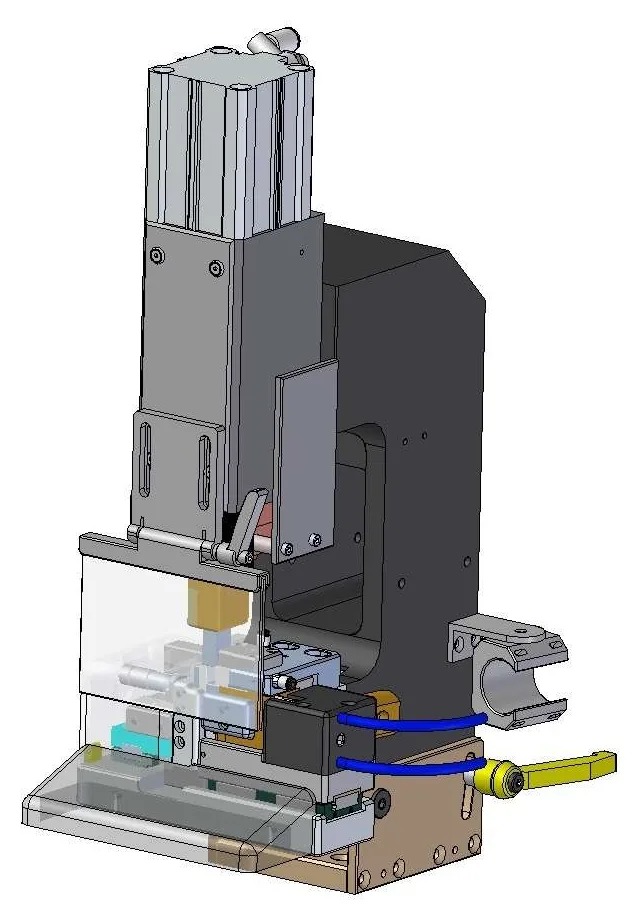
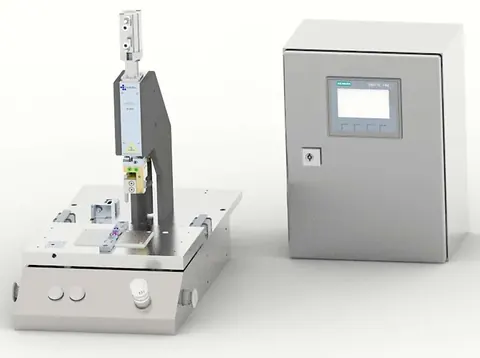 KWZ-Micro with PLC in a cabinet
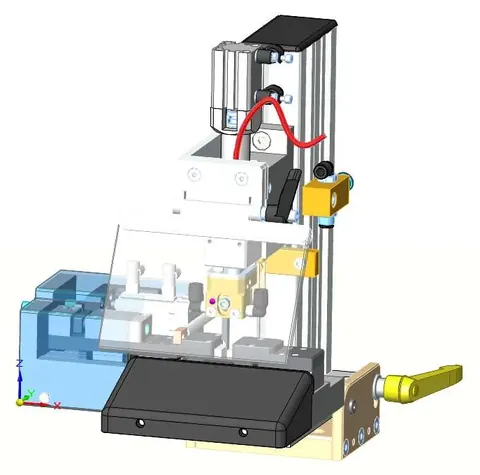 KWZ-05-02 – strands 0.06–0.5 mm²
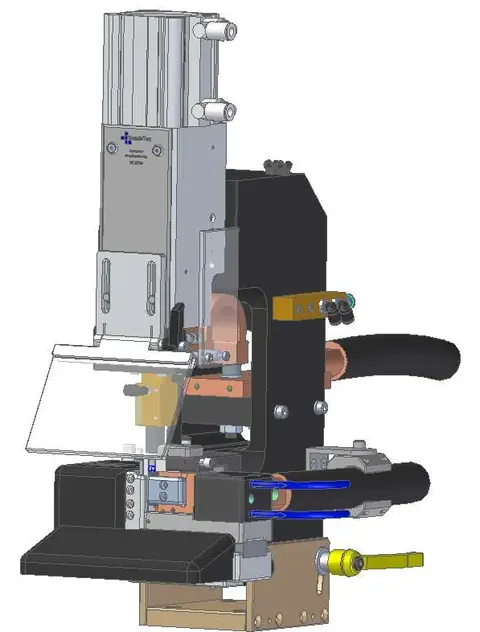 KWZ-15 – also mid-span compacting
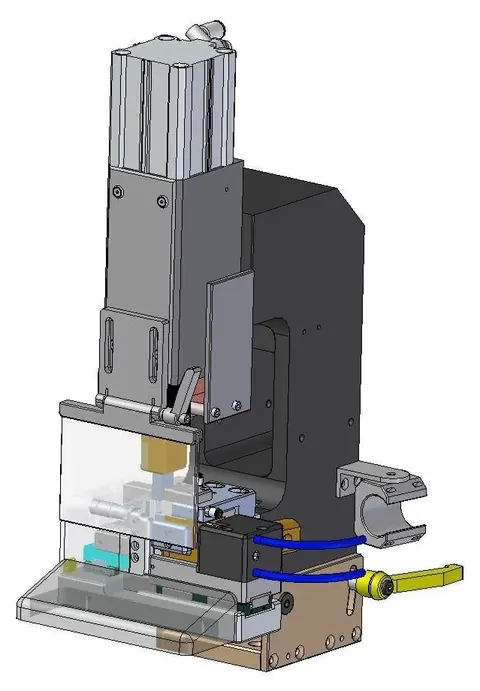 KWZ-15 with spatter guard
The thinnest strands, compacting up to 3 mm, Y- and V-shaped joints, strand extension, welding strands to sensor pins. Integrated PLC: one or two welds per part and up to two welding profiles.
Very thin strands, compacting up to approx. 5.5 mm, water-cooled electrode holder and precise electrode quick-change coupling.
Typical harness strands, compacting up to 14 mm, force approx. 1500 N, current approx. 15 kA. Travel and force measurement as retrofit options.
Same parameters as the KWZ-10, but the strand can be compacted along its entire length, including the middle of the wire (mid-span).
| Model | Strand cross-section | Compacting length | Force (5 bar) | Max. current (20% duty cycle) | Stroke | Weight |
|---|---|---|---|---|---|---|
| KWZ-Micro | 0.1–approx. 1 mm² | max. 3 mm | approx. 500 N (Ø 40) | approx. 5 kA | 20 mm | approx. 17.5 kg (with PLC) |
| KWZ-05-02 | 0.06–0.5 mm² | approx. 5.5 mm | approx. 150 N (Ø 20) | approx. 5 kA | 5 mm | approx. 6.8 kg |
| KWZ-10 | 0.5–approx. 12 mm² | 14 mm | approx. 1500 N (Ø 63) | approx. 15 kA | 10 mm | approx. 33.4 kg |
| KWZ-15 | 0.5–approx. 12 mm², also mid-span | 14 mm | approx. 1500 N (Ø 63) | approx. 15 kA | 10 mm | approx. 33.4 kg |
| KWZ-Splice | 0.5–approx. 12 mm² (sum of wires) | – | approx. 1500 N (Ø 63) | approx. 15 kA | – | approx. 33.4 kg |
| Repeatability | ± 0.05 mm |
|---|---|
| Operating pressure | 2.5–6 bar, air filtered to 5 µm, dry |
| Operating temperature | 0–60 °C |
| Cylinders | KWZ-Micro: Ø 20 / Ø 40 mm • KWZ-05-02: Ø 16 / Ø 20 mm • KWZ-10 / KWZ-15: Ø 40 / Ø 63 mm |
| Air consumption per cycle | 0.16–0.20 l (5 bar, max. stroke) |
| Electrodes | Water-cooled; available for copper and its alloys, steel and stainless steel (KWZ-Micro) |
| Equipment | Displacement sensor, spatter guard, tilting unit, armrest (KWZ-05-02), various follow-up springs |
The choice depends on the strand cross-section: up to 0.5 mm² – KWZ-05-02; up to 1 mm² with Y / V joints or sensor pins – KWZ-Micro; 0.5 to 12 mm² – KWZ-10; and when the strand has to be compacted in the middle of the wire – KWZ-15. For joining several wires into a splice without a ferrule, there is the KWZ-Splice. Trials on your strands can be carried out in the KombiTec lab, and the tool can be mounted on an HA station.
The end of a stranded wire is pressed and heated by current at the same time, so the wires fuse into a solid, rigid block of repeatable shape – without a ferrule.
From 0.06 mm² (KWZ-05-02) through 0.1–1 mm² (KWZ-Micro) to 0.5–12 mm² (KWZ-10, KWZ-15, KWZ-Splice).
Yes, all KWZ tools also compact coated strands.