🎛️ In-process force profile
Electrode force can follow a programmed profile during welding, with real-time control – better, more consistent quality.
KombiTec SKe heads have a servo-electric drive instead of a pneumatic cylinder. The head is controlled directly by the welding inverter, so the electrodes position quickly and precisely, touch down gently on the part, and the electrode force can follow a programmed profile during welding – with real-time control. The result is better joint quality, a shorter cycle and savings on compressed air, one of the most expensive utilities in a plant.
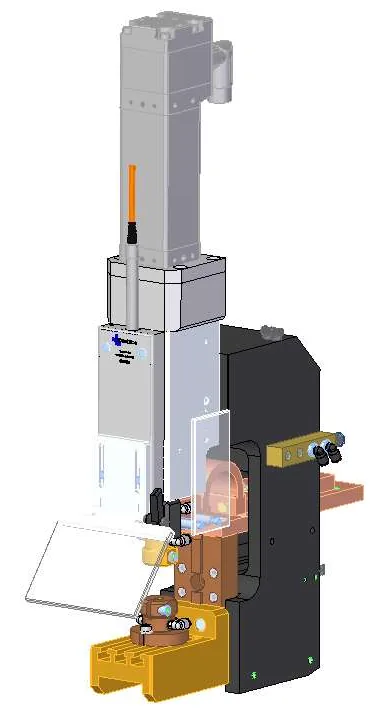
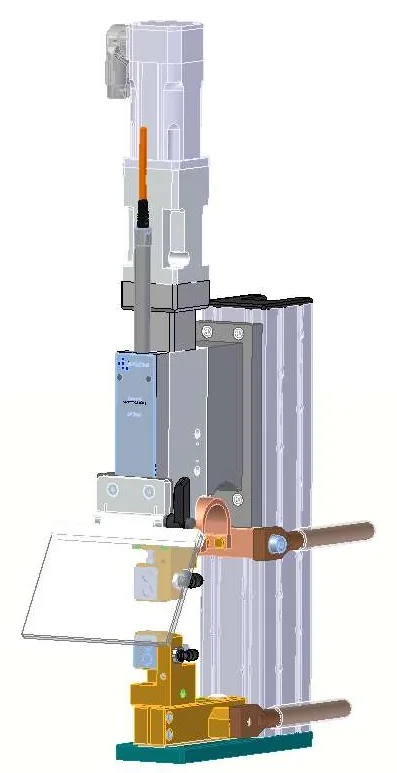 SKe-150 – 150 N servo-electric head
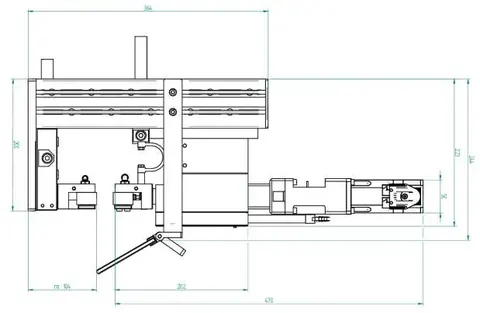 SKe-150 dimensional drawing
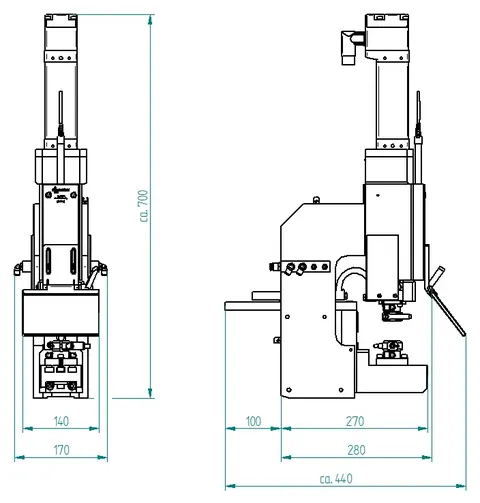 SKe-700 dimensional drawing
Electrode force can follow a programmed profile during welding, with real-time control – better, more consistent quality.
Very fast movements shorten the cycle, and soft electrode touchdown protects sensitive parts.
Inverter-controlled 230 V servo drive – saving one of the most expensive utilities in the plant.
Integrated force measurement, anti-rotation lock, water-cooled electrodes for longer service life.
| Model | Force | Electrode stroke | Max. current (20% duty cycle) | Force measurement | Weight |
|---|---|---|---|---|---|
| SKe-150 | 150 N (more on request) | max. 20 mm | 7 kA | integrated | approx. 13 kg |
| SKe-700 | 700 N, speed up to 635 mm/s | max. 25 mm | 15 kA | strain gauge in the actuator | approx. 25 kg |
| Motor supply | 230 V AC |
|---|---|
| Control | Directly from the welding inverter |
| Repeatability | ± 0.01 mm |
| Operating temperature | 0–50 °C |
| Anti-rotation lock | Yes |
| Equipment | Displacement sensor, spatter guard, water-cooled electrode holder, quick-change coupling (SKe-150) |
When cycle time, gentle contact with the part and full force control during welding matter: welding compacted strands to switch contacts, hot staking, micro-welding and sensitive components. For simpler pneumatic applications there are the SK heads (2–2500 N), and for gap welding the DK dual heads. Compact the strand beforehand with a KWZ tool.
The electrode force and movement are generated by an inverter-controlled servo drive, so the force can follow a profile during welding, movements are faster, and the head uses no compressed air.
SKe-150 – 150 N (more on request), SKe-700 – 700 N at speeds up to 635 mm/s.
For fast, precise applications: welding compacted strands to switch contacts, hot staking, micro-welding and delicate components.